Hidden Photography Locations in Paphos


Why the Best Locations Are Never on the Tourist Map
Every couple planning a photoshoot in Paphos starts by Googling the same handful of locations. Coral Bay Beach. The Paphos harbour. Aphrodite Hills. These are genuinely beautiful places and we shoot at them regularly. But after years of working as a photographer in Paphos, I have also discovered the locations that do not appear in travel guides, that tourists walk straight past, and that produce some of the most extraordinary images I have ever made.
These are the spots where you will not share a sunset with 200 other people. Where the background has not been photographed ten thousand times. Where the light does something unexpected because nobody planned for it to be a photography location in the first place.
This guide shares the hidden gems we return to again and again across our wedding, couple, family, and portrait sessions. Some require a short hike. Some are simply a matter of knowing which unmarked turning to take off a main road. All of them are worth it.
1. The Sea Caves North of Coral Bay
Where the Cliffs Drop Into the Mediterranean
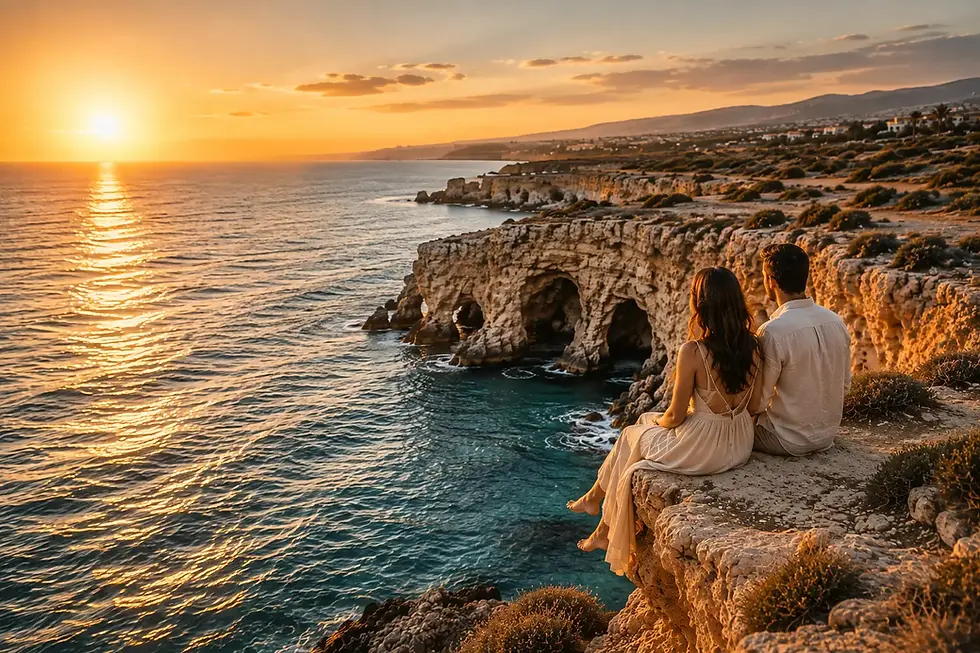
Q: Are there sea caves near Coral Bay Paphos for photography? A: Yes. A short walk north of the main Coral Bay beach, past the headland, brings you to a dramatic clifftop area with natural sea caves carved into the rock face below. This area is largely unknown to visitors who stay at the main beach. The westward facing cliffs catch the full force of the golden hour sun, and the combination of warm light, turquoise water below, and raw limestone rock creates an extraordinary backdrop for couple and portrait photography.
Most visitors to Coral Bay set up their towels on the main beach and never venture further. The rocky path that continues north past the beach feels uninviting and unofficial. That is precisely why it is one of our favourite photography locations in Paphos.
Follow the coastline north on foot for about ten minutes and the landscape transforms entirely. The manicured beach resort gives way to raw Mediterranean clifftop. The ground is limestone and scrub brush. The sea below is impossibly blue and turbulent. And at golden hour, the westward facing rock face glows amber in a way that feels almost unreal.
For couples, this location works best for natural, unposed walking shots and dramatic portrait work. The terrain is uneven so comfortable footwear is essential. We recommend arriving ninety minutes before sunset to have time to explore the terrain before committing to the best spot.
Best for: Couples, engagement shoots, dramatic portrait work.
Best time: One hour before sunset, spring through autumn.
Access: On foot from the northern end of Coral Bay beach. No facilities.
📸 Photographer's Tip: The caves themselves are not accessible by foot from above but they frame beautifully in wide shots from the clifftop. Bring a drone if you have one and drone access for this area. The aerial perspective over the sea caves is genuinely spectacular.
2. The Backstreets of Ktima Old Town
Painted Doors, Stone Walls and Empty Lanes
Q: Where are the best photography spots in Paphos Old Town? A: The best photography spots in Paphos Old Town are not on the main shopping streets but in the quiet backstreets and residential lanes of Ktima, the upper town area. Here you will find hand painted wooden doors in turquoise, ochre, and terracotta set into crumbling limestone walls, bougainvillea cascading over iron gates, and cobblestone lanes that see almost no tourist foot traffic. These locations are excellent for portrait, couple, and family photography.
Every visitor to Paphos walks the main commercial street of Ktima at some point. Very few venture into the quiet residential lanes that run parallel to it. This is where the real character of old Paphos lives.
The backstreets of Ktima are a photographer's archive of textures and colours. Limestone walls weathered to a warm honey tone. Painted wooden shutters in deep blue and faded green. Bougainvillea in violent pink against white render. Occasional cats sleeping on doorsteps. And almost total silence. These streets appear regularly in our couple and engagement sessions because the intimacy and character of the environment produces an entirely different kind of image from anything the coast can offer.
For photography purposes, the best lanes are those running west of the central market area, particularly the quieter streets between the town hall and the old neighbourhoods heading toward the municipal gardens. Early morning light here is exceptional. The lanes run roughly east to west, meaning the morning sun cuts down them horizontally and creates beautiful long shadows and warm directional light.
Best for: Couples, families, portrait sessions, engagement shoots.
Best time: Early morning for long directional shadows; late afternoon for warm reflected light off stone walls.
Access: On foot from anywhere in central Ktima. Look for unmarked residential lanes running parallel to the main shopping street.
📸 Photographer's Tip: Knock gently before photographing directly in front of a private home. Most residents are welcoming, and a brief introduction in any language usually produces a smile. Some of our best environmental portrait backdrops have come from asking permission to use a doorway.
3. Agios Georgios Pegeia
Byzantine Ruins, Sea Views and Total Solitude
Q: What is Agios Georgios Pegeia and is it good for photography? A: Agios Georgios Pegeia is an early Christian archaeological site on the northwestern coast of Cyprus, about fifteen kilometres north of Paphos town. It contains the remains of a sixth century basilica, ancient floor mosaics, and a small historic fishing harbour. The site sits directly on the coastline with unobstructed views across the Mediterranean and is almost always quiet, even in peak season. It is an outstanding photography location for couples, families, and portrait work.
Most visitors to the Paphos area never make it as far as Agios Georgios. It requires a deliberate decision to drive north past the tourist resorts, beyond Coral Bay, and along a coastal road that becomes progressively quieter and more rugged. The reward for that decision is one of the most extraordinary photography environments anywhere in Cyprus.
The ruined basilica walls rise from the scrubland with the sea visible through the arched openings. The ancient mosaic floors catch the evening light in patterns that have survived fifteen centuries. The small harbour below has a handful of fishing boats and a complete absence of tourist infrastructure. Standing here, Paphos feels both ancient and entirely private.
We use this location for couple sessions where couples want something genuinely different from beach and harbour photos. The combination of ancient stone, sea light, and open sky produces images with a timeless, almost cinematic quality. It also works beautifully for family photography when families want an adventurous, exploratory session rather than a staged beach portrait.
Best for: Couples, families, destination wedding pre-shoots, creative portrait work.
Best time: Late afternoon through golden hour. The ruins face west and catch the full sunset.
Access: Drive north from Paphos on the B7 coastal road past Coral Bay. Follow signs for Agios Georgios. Small car park at the site.
📸 Photographer's Tip: Arrive at least ninety minutes before sunset. The site deserves slow exploration and the light changes dramatically across that window. The harbour below the ruins catches the last light beautifully and is worth the short path down from the main site.
4. The Akamas Wildflower Meadows
Cyprus in Full Bloom, Without the Crowds
Q: Where are the wildflower meadows near Paphos for photography? A: The wildflower meadows of the Akamas Peninsula, accessible from the village of Neo Chorio or the Fontana Amoroza area north of Paphos, are at their most spectacular in March, April, and early May. During this period the scrubland transforms into fields of wild orchids, anemones, poppies, and endemic Cypriot flora. The area is part of a protected national park and sees very few visitors outside the main hiking trails.
Spring in Cyprus produces something that most visitors, who come in summer, never witness. The island blooms. The dry scrubland of the Akamas Peninsula transforms in March and April into something that looks more like a botanical garden than a Mediterranean hillside, with wild orchids, red poppies, and endemic species flowering across the landscape.
For portrait and maternity photography in particular, this environment is exceptional. There is something about a figure among wildflowers in soft spring light that produces images of rare tenderness and beauty. We have used this location for maternity sessions, couple shoots, and family sessions alike, and it consistently produces work that feels completely different from anything achievable at the coast.
The best access is from the village of Neo Chorio, heading down toward the coast on the unmarked tracks that run through the scrubland. A vehicle with reasonable ground clearance helps. The meadows themselves are not signposted. Local knowledge is required to find the best spots, which is part of why they remain largely undiscovered.
Best for: Maternity, couples, family lifestyle sessions.
Best season: Mid March through early May only. The flowers are gone by late May.
Access: Via Neo Chorio village, on unmarked tracks. Four wheel drive helpful but not always necessary.
📸 Photographer's Tip: This location is strictly season dependent. If your session falls outside March to May, the wildflowers will not be present. Contact us in advance and we will confirm current conditions before recommending this spot for your session.
5. The Abandoned Village of Droushia and Surroundings
Stone Houses, Silence and the Mountains Behind Paphos
Q: Are there abandoned villages near Paphos good for photography? A: Yes. The Laona plateau villages above Paphos, including Droushia, Ineia, and Arodes, contain partially abandoned traditional stone houses, narrow flagstone lanes, and panoramic views back toward the coast. These villages see almost no tourist traffic and offer a completely different environment from coastal Paphos photography. The combination of rustic stone architecture, mountain air, and the distant sea creates a uniquely atmospheric backdrop.
Twenty minutes drive northeast of Paphos, the landscape changes entirely. The coast gives way to the Laona plateau, a highland area of traditional villages, vineyards, and olive groves. The villages here, including Droushia and Ineia, have been partially depopulated over recent decades, leaving behind a landscape of beautiful old stone architecture that sits almost completely undisturbed.
For photography, these villages offer textures and atmospheres that the coast simply cannot. The golden limestone of old Cypriot construction. Carved wooden doors weathered to silver. Narrow flagstone lanes between houses built centuries apart. Panoramic views south toward the sea that appear as a thin blue line on the horizon. On clear autumn and winter days, the entire Paphos coastline is visible from the plateau.
We use these villages most often for couple sessions where couples want something more editorial and less obviously Mediterranean in feel. The environment suits storytelling photography: walking together through a quiet village lane, sitting in a doorway, exploring an old courtyard. The photos feel less like holiday portraits and more like documentary moments from a life lived well.
Best for: Couples, editorial portrait work, destination wedding pre-shoots.
Best time: Morning light for the warm glow on stone; late afternoon for long shadows in the lanes.
Access: Twenty minutes drive from Paphos via the B7 toward Pegeia, then inland toward Droushia.
📸 Photographer's Tip: Pair this location with a session at Agios Georgios on the same evening. Drive up to the plateau in the morning for the stone village work, then head back down to the coast in time for golden hour at the Byzantine ruins. Two completely different environments in a single session.
6. The Western Pier and Fort Area of Paphos Harbour
The Side of the Harbour Nobody Photographs
Q: What is the best photography spot at Paphos harbour? A: Most photographers and visitors stay on the eastern side of Paphos harbour, close to the restaurants and the castle. The western pier, accessible by walking past the small fishing boat moorings, offers a completely different perspective: the harbour from behind, the castle seen across the water, the open sea to the west, and almost total quiet. At blue hour this location produces some of the most dramatic harbour images available anywhere in Paphos.
Paphos harbour is one of the most photographed locations in Cyprus. The castle, the boats, the restaurants lit up in the evening. We know these images well. What most people do not realise is that the western side of the harbour, the stretch of pier that runs past the working fishing boats and away from the restaurants, offers an entirely different and far more dramatic perspective.
From the western pier, you look back across the harbour with the castle on your right and the open Mediterranean to your left. At sunset the castle is lit in warm amber. At blue hour, the sky turns deep blue behind it and the harbour lights begin to reflect across the still water. Standing here, you are looking at the postcard image of Paphos harbour from the angle that almost nobody ever uses.
This location is particularly powerful for wedding photography in Paphos when couples want a final set of portraits after their reception. The short drive from most Paphos venues takes ten minutes, and twenty minutes at blue hour on the western pier consistently produces images that couples describe as their favourite from the entire day.
Best for: Couples, wedding day blue hour portraits, engagement sessions.
Best time: Thirty minutes after sunset through full blue hour.
Access: Walk past the fishing boat moorings on the western side of the harbour. The pier extends beyond the main tourist area.
📸 Photographer's Tip: Bring a jacket for evening sessions here. The sea breeze at the western pier is significantly stronger than in the sheltered harbour restaurant area, and evenings can be cooler than you expect, particularly in spring and autumn.
Planning Your Session at a Hidden Location
Q: How do you find hidden photography locations in Paphos? A: Finding hidden photography locations in Paphos requires either local knowledge or significant personal exploration. The most reliable approach is working with a Paphos based photographer who knows these spots from direct experience. Most hidden locations are not accessible via Google Maps or travel guides. They are found through years of exploring the island on foot, by car, and with a camera.
Every location in this guide has been found through personal exploration over years of working as a photographer across Paphos and the wider Cyprus area. None of them appear on standard tourist maps. Several require local knowledge to navigate to correctly.
When you book a couple or portrait session with D-Shoot, we always discuss location options in advance based on your style preferences, the time of year, and what kind of images you want to walk away with. If you want something genuinely different from the standard Paphos photography locations, we will always have a suggestion that most people have never heard of.
For couples planning a destination wedding in Cyprus, a pre-wedding session at one of these hidden locations also serves as a valuable opportunity to see parts of Paphos that most visitors never experience. Many couples tell us the location scout session became one of their favourite memories of the whole trip.
You can also read our guide on golden hour photography in Paphos to understand how timing your visit to these locations with the right light can transform your images. And if you are curious about what a full session at one of these spots looks like in practice, our about us page gives you a sense of how we approach location work.
Ready to explore? Get in touch with us here and tell us what kind of session you have in mind. We will match you with the location that fits your story best.
Frequently Asked Questions
Are hidden photography locations in Paphos accessible without a car?
Most of the locations in this guide require a car to reach. Agios Georgios Pegeia, the Akamas meadows, and the Droushia village area are all a twenty to thirty minute drive from central Paphos and have no public transport connections. The Ktima backstreets and the western harbour pier are both walkable from the town centre.
Do you need a permit to photograph at archaeological sites in Cyprus?
Photography for personal and commercial use at most outdoor archaeological sites in Cyprus, including Agios Georgios Pegeia, is generally permitted without a formal permit. Indoor museum photography may have restrictions. We advise confirming current rules with the Department of Antiquities for any specific location if your session involves commercial use or professional equipment setups.
When is the best time of year to visit hidden locations in Paphos for photography?
Spring and autumn are generally best for most of the locations in this guide. The wildflower meadows are strictly a spring experience, available from mid March through early May only. The clifftop and coastal locations are outstanding year round but at their most dramatic in autumn golden hour. Read our full guide on the best season for photography in Cyprus for a detailed breakdown by month.
Can these locations be used for wedding day portraits?
Some of them, yes. The western harbour pier and the Ktima backstreets are both practical for wedding day portrait sessions and require minimal travel from most Paphos venues. The clifftop and Byzantine ruins locations work better as pre-wedding shoot destinations where you have more time and flexibility. Contact us and we will advise based on your specific venue and schedule.


Kommentare